Hyundai Is About To Shock Jeep, Ram With A Santa Fe Extended-Range EV
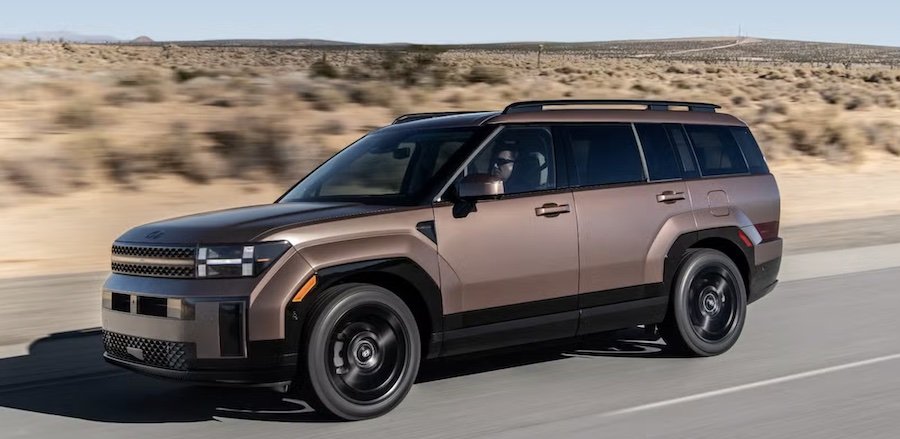
While the Ford Explorer led the pack with 222,706 deliveries in 2025 in the US, the Santa Fe was No. 4 with 142,404, also trailing the Jeep Grand Cherokee (210,082) and Chevrolet Traverse (148,278). So what' is Hyundai's strategy to set the Santa Fe apart from the competition and potentially drive more volume? For now, the plan is to offer a new powertrain, one that is not yet offered in the segment, or in pretty much any segment at the moment.
Santa Fe EREV Built In USA
In the first half of 2027, Hyundai will offer the Santa Fe as an extended-range electric vehicle to be built in the US at its plant in Montgomery, Alabama. Tooling up for this new EREV shouldn't be that difficult because the factory already builds internal-combustion and hybrid versions of the Santa Fe, alongside the Hyundai Tucson and Santa Cruz. Hyundai says it expects the new EREV to deliver more than 600 miles of total range, although most of those miles would require the gasoline engine to be running.
Hyundai has developed its own battery cells, and the automaker says these high-performance cells will power the Santa Fe EREV, while "using less than half the battery capacity of a comparable EV while delivering equivalent battery performance and EV driving dynamics."
Hyundai must be thinking that American shoppers need and want more fuel-efficient options among three-row midsize SUVs, because there are few hybrid offerings in the segment. Previously, there was an Explorer Hybrid and a plug-in hybrid Grand Cherokee 4xe, but those models have left the US market. Among other rivals, there are no hybrid powertrains offered in either the Honda Pilot or Nissan Pathfinder.
In fact, the Santa Fe could be among the first wave of new EREVs coming to the US market, including the Jeep Grand Wagoneer and a new Ram SUV. The Jeep is set to launch later this year, but Hyundai could beat Ram to market. Ford also plans to bring extended-range versions of the F-150, Super Duty, and SUVs to market, eventually.
1.6L Turbo As The Generator?
As the standard-wheelbase Toyota Highlander hybrid goes away, perhaps Hyundai is eager to fill that void with its Santa Fe EREV. Hyundai isn't sharing technical details about its upcoming EREV, but the Santa Fe in the US currently offers a 2.5-liter turbocharged four-cylinder engine rated at 277 horsepower, as well as a plug-less hybrid option that mates a 1.6-liter turbocharged four-cylinder with an electric motor and lithium-ion battery, for a combined 231 horsepower.
Converting to an extended-range variant means using an internal-combustion engine, perhaps the 1.6-liter mill, as a generator that only charges a larger high-voltage battery to turn the wheels. The strict definition of an EREV is that the gasoline engine never turns the wheels directly, unlike in a standard hybrid or plug-in hybrid. But the best way to wring the most efficiency out of an EREV or a PHEV is to plug them in daily. Depending on your driving needs, with regular plugging in, an EREV can run for weeks or even months on a tank of gasoline.
The plug-in hybrid, on the other hand, will run for maybe 40 or 50 miles in all-electric mode before the engine kicks on. Again, plugging in overnight keeps the engine running as little as possible. It's worth noting that the Santa Fe's platform mate, the Kia Sorento, comes available in the US as a hybrid and as a PHEV offering 31 miles of all-electric range. The Sorento PHEV comes to the US from Korea, so it's subject to a 25% tariff. The Santa Fe EREV, assembled in the US, will face no tariff.
