Inside Rimac’s Secretive Factory Where the Bugatti Tourbillon Is Being Built
Key Points
- Rimac showcases transparency in operations and advanced battery tech to YouTuber Misha Charoudin.
- CEO Mate Rimac discusses Tourbillon hybrid hypercar development and heat management challenges.
- Tourbillon deliveries start this year; each costing €3.8 million; extensive in-house processes revealed.
Pulling Back the Curtain
Rimac has been gaining momentum – not only with the record-setting Nevera, but also with its advanced battery technology, which has attracted interest from other automakers. Despite the complexity of its engineering, Rimac remains unusually transparent about how it operates. That openness was on full display thanks to automotive YouTuber Misha Charoudin, who was granted behind-the-scenes access to the company’s facilities.
Charoudin is best known for his content featuring a wide variety of cars driven at the Nürburgring, and his YouTube channel currently boasts around 2.03 million subscribers. He also previously worked at Rimac, giving him unique insight into the company. During the visit, he met with CEO Mate Rimac, who provided detailed explanations of the firm’s operations and development philosophy.
The Birthplace of Tourbillon
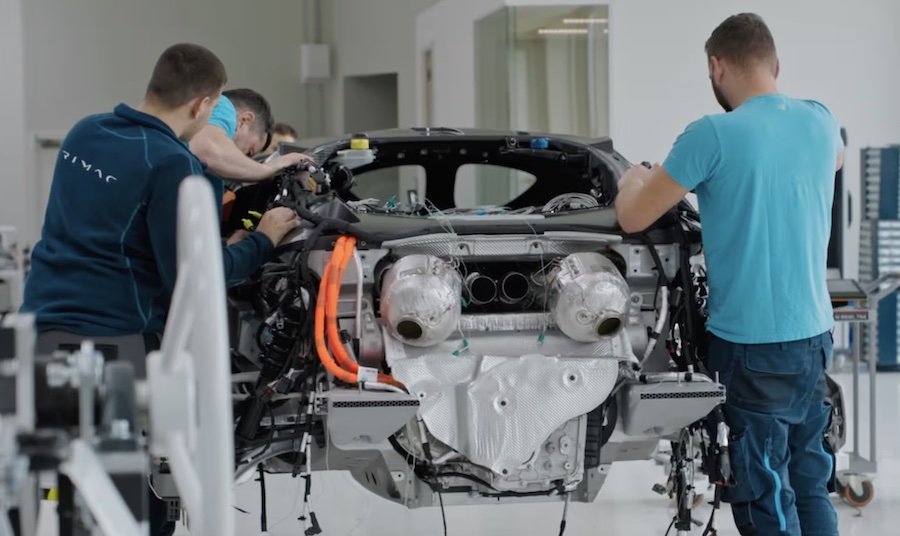
The tour began at the Jankomir Battery and Powertrain production line in Croatia, where Rimac – a majority owner of Bugatti-Rimac –is developing the successor to the Chiron, the Tourbillon. The hypercar abandons turbocharging in favor of a hybridized setup, a move Rimac said was key to enabling the Tourbillon’s naturally aspirated V16 engine.
Rimac also acknowledged growing pressure from Chinese automakers that are rapidly advancing battery technology, remarking, “They are really, really good at doing this stuff.” That progress was highlighted when Xiaomi, best known for smartphones, beat the Nevera’s Nürburgring lap time with its SU7 Ultra EV, which is claimed to produce 1,527 horsepower.
One of the biggest challenges in developing the Tourbillon, according to Rimac, has been heat management. Integrating the hybrid system required careful thermal control to ensure the components were protected from extreme heat, with the inverter mounted above the exhaust, which can reach temperatures of up to 900° Celsius (1,652° Fahrenheit). To validate its thermal solutions, the team is said to have conducted real-world testing in Dubai, where ambient temperatures are extreme, alongside extensive simulations and wind-tunnel testing.
Mate Rimac also showcased his personal car collection, which includes the Pininfarina Battista, Mercedes-Benz SLR McLaren, and Porsche Carrera GT. Despite the cult following surrounding the BMW E30 M3, he described it as “boring” to drive. His personal favorite is the BMW 5 Series (E39), which he regularly uses as a daily driver alongside Bugatti and Rimac vehicles.
No Need for Mystery
Other Rimac facilities shown were the carbon-fiber production area, the paint shop – where up to 800 hours of work is said to go into each car on average – and a battery production line supplying BMW, though the specific models were not disclosed.
While many automakers remain reserved about their manufacturing processes, Rimac has taken a different approach. That transparency is somewhat ironic given Bugatti’s famous tagline, “If it’s comparable, it is no longer a Bugatti,” yet it also reflects confidence in the company’s engineering and development phasing.
The clearest expression of that confidence is the Tourbillon itself, with first deliveries expected later this year. Each example starts at around €3.8 million (approximately $4.6 million).
