The 2027 Audi RS5 Is Here With A Plug-In Hybrid V6 To Embarrass The AMG C63
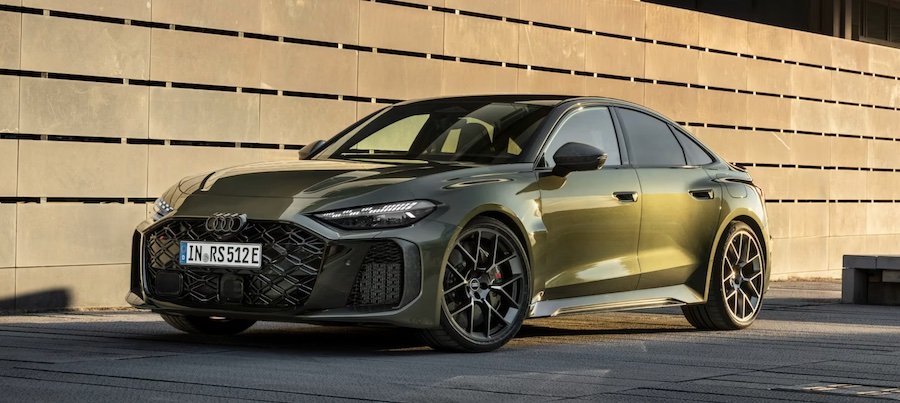
Mercedes even did the latter with two fewer cylinders and electric power. So, Audi needs to really up its game, and this new generation of RS 5 may do just that.
More Than 600 Horsepower With Hybrid Power
Fixing the power problem is, once again, Audi's twin-turbocharged 2.9-liter V6. For this new model, though, that engine has been revised for more power, and it has been supplemented with hybrid power. The engine on its own makes 503 horsepower and 443 pound-feet of torque, and its nearly 60-hp gain comes from a revised fuel system, intake, and the first implementation of water-to-air intercoolers on the model. The plug-in hybrid system can contribute 161 hp and 339 lb-ft of torque through a single motor integrated in the 8-speed automatic transmission where it connects to the engine.
In total, the RS 5 makes 630 hp and 608 lb-ft, which is about 100 extra ponies and 130 lb-ft of twist over the most powerful M3 available. However, the Mercedes-AMG C63 S E Performance still has the Audi bested by around 40 hp and more than 100 lb-ft. Audi claims that the RS 5 will go from 0-62 mph in 3.6 seconds, which puts it very close to the top-rung BMW M3 Competition's 3.4-second 0-60 mph time, and the C63's 3.3-second run.
Similar to the Mercedes, the Audi is not just a hybrid, but a plug-in hybrid. Unlike the Mercedes, the Audi actually has some truly usable battery capacity. The RS 5's battery has a total capacity of 25.9 kWh, with a usable rating of 22 kWh. That's roughly four times the size of the C63's battery pack, and Audi says it should be good for up to 52 miles of fully electric driving. That estimate is not based on EPA testing, so the actual number will likely be lower for the U.S., but that will still surely be better than the C63's paltry three miles. Fuel economy could be solid, too, as the non-EPA estimates are between 52.3 and 61.9 mpg with a full battery, and 23.1 to 24.8 mpg with a drained battery.
The Hybrid System Does More Than Add Power
Audi has more trick details beyond the engine and transmission. The company has fitted a limited-slip center differential with a bit of preload. Audi says this increases the amount of time that axles are locked and improves how quickly it can get power to the wheels. As for the power split front and rear, it can vary between 70/30 and 15/85. Audi even added an RS Torque Rear drive mode that is designed to bias torque to the rear and reduce traction intervention for drifting.
More interesting, though, is the rear differential. It's what Audi calls an electro-mechanical limited-slip differential, and it's the first the company has used. It combines a simple open differential with an 11-hp electric motor (powered by the drive battery) and planetary gear set on one side of the differential.
Our understanding is that the electric motor is able to apply torque either forward or backward at different levels to finely tune how much torque goes to one axle or the other. In a way, it's like how brake-based limited-slip differentials can redirect some torque by applying brake pressure, and thus a little drag, on one axle. Of course, this system should be much faster, more precise, and not use consumable parts.
Audi Didn't Forget About Chassis Upgrades
Naturally, the RS 5 has improved suspension and braking components. Audi reinforced the chassis, making it 10% more rigid than a regular A5, and Audi updated various bushings and joints throughout the independent front and rear suspension. The car also features new dual-valve adaptive shocks which are able to vary both compression and rebound damping. The steering has been retuned and features a quicker 13:1 steering ratio.
Both steel and carbon ceramic brakes are available. The stock ones are steel and measure 16.5 inches up front and 15.7 at the rear. The carbon ceramic brakes are larger at 17.3 inches front and 16.1 inches rear. Audi says the ceramic set even saves 66 lbs over the steel set. It's not a bad idea to try and save some weight, too, since the sedan (technically hatchback) weighs 5,192 lbs, and the wagon weighs 5,225 lbs.
One Of The Meanest Looking RS Models We've Seen
While the performance is the main draw, there's no question that the RS 5's styling will be another. A major factor is the added width. Both body styles are an extra 3.5 inches wider than the standard A5, and that width is emphasized by how much the fenders bubble out from the body. Huge, vertical, functional heat extractor vents also adorn the front fenders. They house wide wheels, with the optional forged 21-inch wheels measuring 10 inches at the front and 10.5 at the rear.
Naturally, the front grilles are even larger than before, and they're finished in black or optional carbon fiber to make it look like one enormous maw. The rear features a huge diffuser and equally huge oval exhaust tips, a long-running signature of Audi's RS models. Opting for the Audi Sport option brings some unique trim, bronze-painted brake calipers, louder exhaust, exclusive 21-inch wheels and a raised speed limiter (177 mph). It also makes the Bedford Green paint available, as shown on the sedan in these photos.
Inside, Audi adds more supportive bucket seats that come standard with massage functions. They're adorned with honeycomb top-stitching, which is finished in bronze with the Audi Sport package. The seats are finished in faux suede as standard with real leather options available, and the dash can have various materials as trim such as carbon fiber and aluminum. The various screens get tweaked graphics to match the RS vibes, and the car has the ability to record lap times and other telemetry. Audi even offers a dashcam that can connect to the system.
Related News
