Ferrari Elettrica Details Emerge: 1,100 HP, Drift Mode, And More
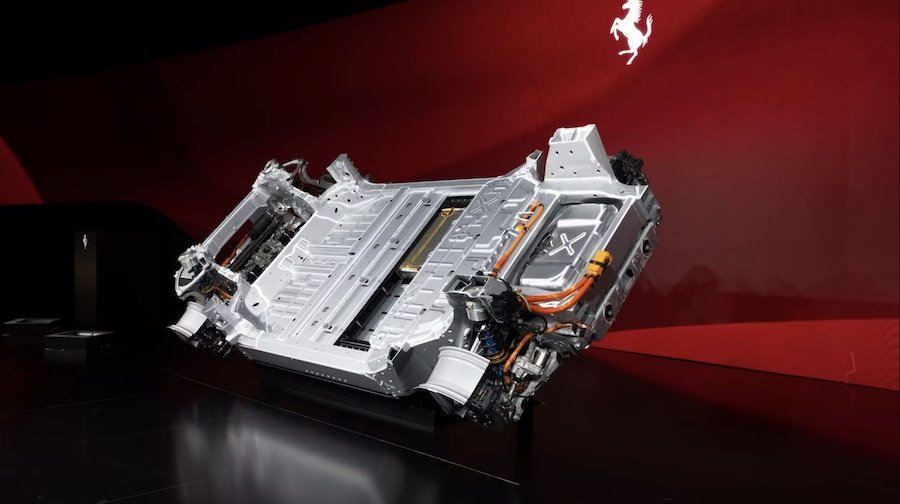
Today, at the company's Capital Markets Day, it has revealed more about the chassis of the new EV. The "culmination of a long journey of technological research," as Ferrari calls it, that started with its F1 car in 2009.
The Italian automaker's press release starts with talk of carbon footprints and recycled aluminum, but, well, nobody cares. What we care about are the electric drive axles. The Ferrari Elettrica platform will attach two motors to each axle. That means four motors to drive this beast.
1,141 Prancing Electric Horses At Your Command
While Mercedes-Benz is moving to its fancy axial flux motors with incredible power density, Ferrari is sticking with a more conventional desStill, they're impressive, with a peak power of 416 horsepower at the rear and 141 at the front. That's per motor, by the way, putting the total output figure at 1,141 electric horses.
Ferrari says its motors are small and light, with a power density of 2.2 kW/lb at the back and 1.5 at the front. That doesn't quite match some of the ultra-fast EVs like the Lucid Air Sapphire, but it is better than a Tesla Model S Plaid.
Up front, the electric motors are capable of accelerating from a stop to 30,000 rpm in under a second. While traction (and weight) limits that acceleration when you're driving, it shows how quickly the vehicle is able to make power when commanded. The response should destroy any gas-powered Ferrari.
The Elettrica won't be the only Ferrari to get this new front motor package (which Ferrari calls electric engines). The F80 will have the same front axle, which is actually where it was originally designed to go.
Ferrari's battery is built into the center of the car, lowering the center of gravity nearly three inches versus an ICE equivalent. It's part of the chassis to make it lighter and stiffer, and most of the weight will be behind the driver (but ahead of the rear axle). This, Ferrari says, helps make the wheelbase shorter but also to minimize the car's moment of inertia when you're turning.
If this was a gas car, we'd say that the engine and transmission were stressed members of the chassis. Just like an F1 car. Ferrari describes the battery pack as a structural element, and says that approach gives it best-in-class energy density of 195 Wh/kg and power density of 1.3 kW/kg. It was also designed and built entirely in-house.
The other big worry of an electric Ferrari is the sound. It's just not possible to recreate a screaming V12 without a screaming V12. So instead, Ferrari will highlight what it has. A sensor on the rear axle will act like a microphone, and the frequencies of the system will be amplified and projected. The company likens it to an electric guitar, where the sound is amplified not simply resonated.
It calls the result "an authentic voice unique to the electric engine which, however, only makes itself heard when functionally useful." The rest of the time it's silent, because that's one of the perks of an EV... yes, even a Ferrari one. While we've reported on a pair of trademarks from the brand covering new ways to make sound, this doesn't seem to match either of those.
Ferrari has crammed a 122-kWh pack into the Elettrica. It says that it will deliver around 330 miles of range, which isn't bad for a vehicle about the size of the V12 Purosangue SUV. Individual modules of the pack can be replaced, and so the whole thing can be upgraded if new chemistries offer improvements in the future.
Despite the battery and four motors, this isn't as heavy as expected. The estimated weight is just under 5,100 pounds. Yes, that's still 2.5 tons, but it's only a couple of hundred pounds more than the Purosangue. Sprinting from zero to 62 mph will take around 2.5 seconds and the top speed is 191 miles per hour. Not too shabby, though it might still get dusted by a Taycan Turbo.
Like every modern Ferrari, it will have a high-tech suspension system. The new third-generation active system has a different thread pitch on the screw that activates it, which Ferrari says will improve ride quality. The system is faster-acting than before, canceling out the longer thread pitch when the suspension is controlling the body. Rear-steer, carbon ceramic brakes, and four-motor torque vectoring will all be part of it, with a drift mode to let you hang the tail out driving the back tires.
So that's the what, now how about the when? Expect a full look at the new vehicle, including the bodywork, sometime early next year. The first customer deliveries are expected near the end of 2026.
Related News
